Horse racing betting in New Zealand in 2026: one lawful operator, ten brands New Zealand punters meet, and what every price on the slip actually costs
 Available in US
A punter sitting down to bet on a horse race in New Zealand in 2026 has fewer real choices than the marketing on their phone suggests. One operator — TAB NZ, trading as TAB and as Betcha — is the only provider lawfully allowed to offer those bets to people in New Zealand. Every other brand a reader sees advertised is in New Zealand without a licence, and the difference is not branding: it is whether New Zealand harm-minimisation rules, a New Zealand complaints route, and the operator’s own obligation under section 74AAA of the Racing Industry Act 2020 apply at all.

Current as of 30 October 2026 — verified against the Racing Industry Act 2020 (as amended by the Racing Industry Amendment Act 2025) and the Department of Internal Affairs’ public statement on the betting prohibition.
TAB and Betcha are the lawful choice; eight other brands sit below them, and the page says plainly what each offers and what each costs the reader, in that order. The maths underneath a price — the margin the bookmaker keeps of every dollar bet, and what a multi, an each-way wager or a Same Game Multi actually returns — is how the reader sees the cost of the bet.
Table of Contents
- The app most New Zealand horse racing bets go through: TAB NZ’s mobile product
- In-running and the cash-out question on New Zealand racing
- Forecasting and the punter’s edge on a Saturday card
- Bet types, odds, and what an each-way wager really costs a New Zealand punter
- Fixtures, meetings and what a New Zealand punter bets on through the year
- How a New Zealand horse racing bet is actually placed
- Ten bookmakers a New Zealand punter meets — and how each one compares
- What the racing betting market in New Zealand actually is
- New Zealand law and the offshore bookmaker in one place
- Player protection, harm minimisation and where a New Zealand punter gets help
- Bonuses, free bets and what the marketing word actually costs
- The maths of a price: margin, payout share and what a winning bet returns
- Frequently asked questions
The app most New Zealand horse racing bets go through: TAB NZ’s mobile product
The TAB NZ app, listed on the New Zealand App Store under the seller name New Zealand Racing Board and first released on 8 September 2014, is the front door for almost every legal horse racing bet in the country. Its second brand, Betcha, sits in the same App Store under the publisher Entain New Zealand Limited and shipped on 6 August 2024. Both belong to TAB New Zealand; the two are not rivals, and the page treats them as one operator group throughout.

Both apps carry the markets that matter for racing. Pre-match and live, both cover thoroughbred, harness and — until greyhound racing closes in stages from 1 August 2026 — greyhound meetings. Both apps carry racing form, the Blackbook tool for tracking horses, Jockey Challenge, and the simplified deposit and withdrawal wallet. TAB carries Trackside live race streaming inside the app, with in-play betting layered on top; Betcha, marketed to a younger crowd and built around same-game multis, runs in-play markets without the broadcast.
What the app costs the reader comes down to three things. First, the price the market posts. Second, the margin that sits inside every decimal odds figure on the slip. Third, the time it takes for a withdrawal to clear — debit-card payouts in New Zealand typically clear in one to three working days at TAB, and bank transfers to New Zealand accounts in the same window; Betcha is newer and runs the same back-end, so the difference is mostly product shape, not plumbing. The age rating is 17+ on the App Store; the betting age is 18, and accounts are gated to a verified New Zealand address and identity document.
Anyone comparing the two on mobile alone is choosing between two surfaces of the same product. TAB carries the streaming, the form-heavy toolset and the multi-vertical wallet; Betcha is the lighter, mobile-first skin built around accumulators and Same Game Multis. A punter whose week is dominated by Saturday racing and who wants the broadcast picks TAB; a punter whose betting is a multi before the first race and nothing after the last picks Betcha.
In-running and the cash-out question on New Zealand racing
Live betting on horse racing in New Zealand runs through TAB and Betcha, and the markets a punter sees at the off are not the markets they will see three furlongs in. The in-play product at TAB includes the standard win and place ladders, plus a derivative set — a running double settled into the result of the next race, Quaddie legs that move as the field sizes shorten, and Same Game Multis inside a single meeting.
Cash-out, as a mechanism, is what the marketing calls “take your money and run”. The TAB NZ apps list a cash-out button on selected bet types; what it actually does is close the bet at a price the operator has just generated. The price the operator generates is the market price at that instant, minus the margin that sits inside every decimal odds figure on the slip. A cash-out live, by construction, pays the punter less than the true market value of the bet at that moment — because if it paid more, the operator closes the offer.
For a punter, the cost of cash-out is the spread between the live cash-out price and the live “hold” price they realise by waiting for the result. On short-priced favourites at the off, that spread is small and the cash-out is a real hedge. On long shots, where the operator is exposed to the tail of the payout curve, the spread is wider and the cash-out becomes a quiet way to lock in a loss. The page does not say when to cash out, because that depends on the race; the page says the cash-out price is the operator’s price, not the market’s, and the reader is wise to look at the slip before tapping it.
Forecasting and the punter’s edge on a Saturday card
Best bets, best systems and “the smart punt” are the phrases the searcher brings to the page. New Zealand racing is a thin market in the technical sense — fewer runners per race than the European or American cards the searcher may be used to — and a card of seven runners at Trentham is a different statistical animal from a field of twenty at Royal Ascot. Whatever system a punter runs, it has to be calibrated to that field size, because most published systems assume a deeper pool of runners than a New Zealand meeting offers.
What the punter actually controls is the price they take, the stake they put down, and the moment they walk away. A punter who reads the form, follows the going, tracks the jockey bookings and lays out a staking plan before the meeting is in a different position from one who bets by name. A punter who chases losses by doubling the stake after a bad race is running a system that does not work; the expected value of the next bet is whatever the market says it is, independent of what the previous one did.
The honest framing for a forecasting system on New Zealand racing: form, going, jockey, barrier draw, race tempo and field size are the six inputs the form guides give for free; a punter who weights all six beats a punter who weights one of them with conviction. None of that produces a winner on its own. The maths the page runs in the calculation section shows why: the margin inside every price means the punter has to find an edge before the bet is placed, and a “system” that does not beat the margin is a way to lose money slowly.
Bet types, odds, and what an each-way wager really costs a New Zealand punter
New Zealand racing bet types come from the TAB NZ rulebook: Win, Place, Each Way, Quinella, Exacta, Trifecta, First4, Double, Treble, Daily Double, Running Double, Quaddie and Big6, plus Multis and Same Game Multis on the racing product. Most of those names are familiar to anyone who has bet on a Melbourne Cup sweep; the pricing and place terms are where the surprise lives.
An each-way bet is two bets, a win bet and a place bet, and the stake is doubled by construction. A $10 each-way bet costs $20. The return on the win half is the win dividend; the return on the place half is the place dividend. For a horse at $10.00 decimal odds (9/1 fractional) with 1/4 place terms paying three places, a $10 each-way bet returns about $110 on the win half if it wins, and roughly $35 on the place half, giving a total return close to $145 if the horse wins and about $35 if it only places. The place dividend is set by the TAB NZ dividend declaration after the race, and the place payout does not equal the win payout; it equals a fraction of it defined by the place terms.
UK each-way place terms are the most common the punter will meet in published guides: handicaps with more than fifteen runners pay 1/4 odds for four places; twelve to fifteen runners pay 1/4 for three places; other races with more than seven runners pay 1/5 for three places; five to seven runners pay 1/4 for two places; fewer than five runners pay only on a win. New Zealand place terms follow the same shape but are set by TAB NZ for each meeting and printed on the betting slip; a punter betting each-way on a New Zealand race reads the place terms on the day’s race card, not the UK default.
The handicap race is a separate concept that matters for the bet type. In handicap races each horse is assigned a different weight to carry, based on its assessed ability, so the field theoretically starts closer together. In conditions races horses carry the same weight, with allowances for younger and female horses. Flat racing is run between two points around a straight or oval track; jump racing is steeplechasing and hurdling, what the British and Irish call National Hunt racing. Flat races range from 440 yards (400 m) to more than four miles (6.4 km), with five to twelve furlongs (1.0 to 2.4 km) the most common distances. The British Triple Crown consists of the 2000 Guineas, the Derby and the St Leger.
Same Game Multis, the racing version of a bet builder, let a punter combine two or more markets from the same race — win, place, head-to-head, margin of victory — into a single price. The legs multiply into one combined decimal odds figure; the margin applies once, on the combined price, which is why a Same Game Multi on a single race usually pays less than the punter expects from multiplying the legs by hand. The Same Game Multi is also where a Same Race Multi sits at the meeting level, allowing the punter to back runners and place horses across races on the same card; the cost is the same margin multiplied across the legs.
Fixtures, meetings and what a New Zealand punter bets on through the year
The New Zealand racing calendar is built around the thoroughbred code, with harness (trots) running alongside it and greyhound racing closing in stages from 1 August 2026. The big-draw meetings are the ones a Melbourne Cup sweep sits inside: Cup Day in November, the Auckland Cup meeting at Ellerslie in March, and the New Zealand Derby at Trentham in the same window. These are the meetings where the place terms move, the field sizes lengthen, and the multis pay the most because the field of runners is wide enough for a longshot to land.
For a punter, the meeting is the unit of work, not the race. A Saturday at Trentham is a card of eight to ten races with a Quaddie running across the last four; the punter who treats the Quaddie as the day’s bet, not as four separate bets, sees a different cost profile from the punter who backs runners race by race. The Quaddie is a pool bet, which means the dividend is set by the pool of money taken and the winners who hit all four legs; the dividend is not known until the last leg is run. The punter cost is the stake against the pool, and the expected return is the dividend the pool declares.
What is on the betting programme at TAB NZ beyond racing is a rugby union and rugby league season running through the southern winter, the domestic cricket season in the warmer months, and international sport year-round. The punter who mixes racing multis with rugby or cricket multis on the same slip sees the same margin treatment but a different race structure, and the page notes in passing that field sizes in team sports are constant (two teams, or two outcomes plus the draw in some codes) in a way racing is not. The cost difference is real: a $10 multi on three short-priced favourites in team sport has a tighter margin profile than a $10 multi on three New Zealand racing fancies, because the bookmaker runs the team-sport book with a thinner margin than the racing book.
How a New Zealand horse racing bet is actually placed
The mechanics for a New Zealand punter are short and stable. Open an account with TAB or Betcha through the app or the website, verify identity and New Zealand address, deposit from a New Zealand bank account or debit card, pick a race meeting, build a bet slip, place the bet, and watch the dividend. Withdrawal back to a New Zealand bank account or debit card clears in one to three working days at TAB; Betcha runs the same back-end on the Entain side.
A punter who bets on racing for the first time in New Zealand has three things to settle before placing the first bet. The race meeting and the race — which meeting is on, what the field size is, what the going is. The bet type — Win, Place, Each Way, or a multi. The stake — how much of the bankroll goes on this single bet. The “how to bet on a horse race for dummies” search query the page meets is asking for the order of those three things, in that order; everything else is product detail.
The TAB NZ app also runs a trackside live race streaming service inside the app, with in-app betting layered on the broadcast, so a punter who cannot get to Trentham can still watch the race and bet on it. The punter who watches the race live and bets in-running carries the cost the cash-out section describes: the in-running price is the operator’s price, and the punter who chases the race with a phone pays for the chase in spread.
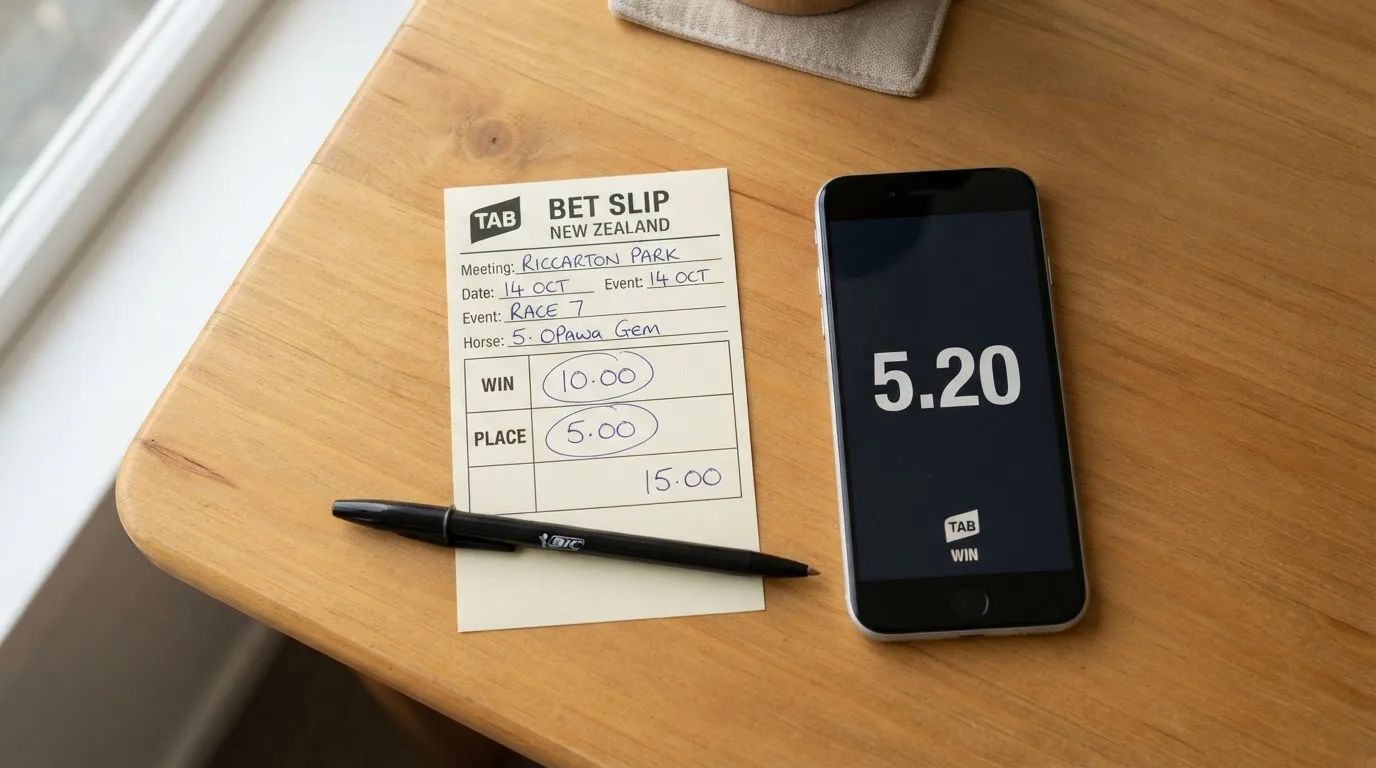
The cost of a first bet, in dollars, depends on the price of the runner and the type of bet. A $5 win bet on a $5.00 runner pays $25 if it wins and $0 if it does not. A $5 each-way bet on the same runner costs $10 and pays $12.50 on the place half if it places at 1/4 place terms, or $25 on the win half if it wins plus the $12.50 place half. The punter’s bankroll is the constraint; the margin is the cost of every bet they place on the slip.
Ten bookmakers a New Zealand punter meets — and how each one compares
The ten brands below are the ones a New Zealand punter sees in their inbox, on social, in sponsored search results, and on the racing broadcasts. Two are lawful under New Zealand law; eight are not. The table that follows is not a ranking and not a recommendation: it sets the lawful option against the unlawful options on the same fields, so the reader can see, line by line, what each one offers and what each one costs.
Operator comparison at a glance
| Brand | New Zealand status | What the operator’s own terms state on the key’s subject |
|---|---|---|
| TAB | One of two online brands of TAB NZ (with Betcha), the only provider lawfully offering racing and sports betting to people in New Zealand (Racing Industry Act 2020, section 74AAA, in force since 28 June 2025) | TAB NZ app on the NZ App Store since 8 September 2014; deposit limits, timeouts and self-exclusion; Trackside live streaming inside the app; racing form, Blackbook and Jockey Challenge tools; 1–3 working day payouts to NZ bank or debit card; 18+; New Zealand address and ID required |
| Betcha | One of two online brands of TAB NZ (with TAB), the only provider lawfully offering racing and sports betting to people in New Zealand (Racing Industry Act 2020, section 74AAA, in force since 28 June 2025) | Betcha app on the NZ App Store since 6 August 2024; same TAB NZ wallet, deposit limits and self-exclusion framework; Same Game Multi-led product; lighter interface aimed at multis and same-race multis |
| Rooster.bet | Not licensed in New Zealand — only TAB NZ may offer racing and sports betting to people in New Zealand (section 74AAA); the brand names a Tobique Gaming Commission e-gaming licence, no right to take bets from people in New Zealand | Live, Sports Promotions, Results, Schedule, E-sports and Predictions sections; odds shown in six formats |
| Golden Panda | Not licensed in New Zealand — only TAB NZ may offer racing and sports betting to people in New Zealand (section 74AAA); the brand names no licence that applies in New Zealand | Sports section with a sportsbook, esports and virtual sports, plus casino, live casino, crash games, rewards, cashback, a VIP Club, Golden Goals and Prediction Markets |
| BetNinja | Not licensed in New Zealand — only TAB NZ may offer racing and sports betting to people in New Zealand (section 74AAA); the brand names a licence from the Union of the Comoros, no right to take bets from people in New Zealand | Casino welcome of EUR 1,000 bonus and 100 free spins; sports offer of a 100% match up to EUR 100 on the first deposit |
| BetAlright | Not licensed in New Zealand — only TAB NZ may offer racing and sports betting to people in New Zealand (section 74AAA); the brand names no licence that applies in New Zealand | Sportsbook covering football, tennis, table tennis, basketball, ice hockey, American football and baseball, with Live Betting and Virtual Sports sections |
| FunBet | Not licensed in New Zealand — only TAB NZ may offer racing and sports betting to people in New Zealand (section 74AAA); the brand names no licence that applies in New Zealand | Sportsbook on football, ice hockey, American football, basketball, volleyball, tennis, rugby and baseball, with live betting and a 24/7 bookmaker |
| Spinbara | Not licensed in New Zealand — only TAB NZ may offer racing and sports betting to people in New Zealand (section 74AAA); the brand names no licence that applies in New Zealand | First-deposit bonus of 100% up to EUR 100; sport crypto welcome bonus of 100% up to 200 USDT; casino welcome bonus of 100% up to EUR 500 plus 200 free spins |
| 22Bet | Not licensed in New Zealand — only TAB NZ may offer racing and sports betting to people in New Zealand (section 74AAA); the brand names a Curaçao licence, holder TechSolutions Group N.V., no right to take bets from people in New Zealand | Over 30 market types per event: 1X2, Double Chance, totals, both teams to score, correct score, HT-FT, plus tennis game, set and handicap markets |
| Telbet | Not licensed in New Zealand — only TAB NZ may offer racing and sports betting to people in New Zealand (section 74AAA); the brand names no licence that applies in New Zealand | Crypto casino and sportsbook; welcome offer of 200% up to 1 BTC plus 50 free spins and a 5 USDT free bet on the Russian-language site |
The column on the New Zealand status is the column that decides everything else for a New Zealand reader. TAB and Betcha are the lawful path; the other eight are what New Zealand law calls an unlawful offer, and the Department of Internal Affairs’ public statement on the betting prohibition is the source. The third column is what each operator’s own site says it offers, transcribed from the operator’s own terms. The reader’s job is to weigh a lawful offer with a New Zealand complaints route against an unlawful offer with none, knowing that the offshore brand is taking a New Zealand bet in breach of section 74AAA.
TAB: the lawful choice and what the product costs
TAB NZ runs the monopoly’s racing product and sports betting from the same app and the same back-end, with Entain running the technology and the trading under a 25-year agreement signed in 2023. The deal gives Entain a 50/50 share of gross profits, with at least $150 million a year going to TAB NZ for the first five years, and a one-off $100 million payment to the racing sector from Entain. The page notes that partnership because it is what makes the product stable: TAB NZ is the operator; Entain is the technology and trading partner; the punter’s account, wallet and dividend come from TAB NZ.
What TAB NZ’s product gives the punter: full New Zealand racing coverage (thoroughbred, harness, greyhound until 1 August 2026), Trackside live streaming inside the app, racing form and Blackbook tools, Jockey Challenge, a Same Game Multi product across both racing and team sport, the standard pool products (Quaddie, Big6, Double, Running Double), fixed-odds Win, Place and Each Way, and the safer-gambling tools named in the App Store listing — deposit limits, timeouts, self-exclusion — plus the free Gambling Helpline (0800 654 655) and the text line 8006. The product is not cheap; the product is the lawful one. The cost of every bet is the margin inside the price, and the margin on a TAB NZ racing book sits in the band the calculation section states.
The verdict on TAB: the only lawful operator in New Zealand, the one whose dividend declarations are public, whose self-exclusion crosses brands, and whose harm-minimisation tools meet the standards the Gambling Act 2003 requires. A punter who bets at TAB is betting under New Zealand law with a New Zealand complaints route; a punter who bets offshore is not.
Betcha: the second skin of the same operator
Betcha is the younger of the two TAB NZ brands, first released on the New Zealand App Store on 6 August 2024, published by Entain New Zealand Limited. It is not a rival bookmaker to TAB; it is a second product surface, built mobile-first, aimed at the Same Game Multi and accumulator punter, and run on the same TAB NZ wallet.
What Betcha gives the punter over TAB: a lighter interface, a Same Game Multi-led product layout, the same racing and sports coverage, and the same self-exclusion framework that crosses to TAB. What Betcha does not give: the Trackside live race streaming layer that TAB carries inside its app. The punter choosing between them is choosing between a multis-first product and a broadcast-first product, both under the same New Zealand law and both running on the same wallet.
The verdict on Betcha: for the punter whose betting life is a multi before the first race and nothing after the last, Betcha is the cleaner surface. For the punter who wants to watch the race live and bet in-running from the broadcast, TAB is the one. The two are not two bookmakers; they are two apps over one book.
Rooster.bet: what it offers, and what it costs the New Zealand punter
Rooster.bet runs a sportsbook with Live, Sports Promotions, Results, Schedule, E-sports and Predictions sections, and shows odds in six formats. The brand names a Tobique Gaming Commission e-gaming licence (No. 0000002), held by Novatrix SRL. None of that gives Rooster.bet any right to take bets from people in New Zealand under section 74AAA of the Racing Industry Act 2020; the brand sits outside the New Zealand framework.
For a New Zealand punter, the cost of Rooster.bet is the absence of a New Zealand complaints route and harm-minimisation framework. The Department of Internal Affairs warns that overseas operators offer minimal consumer safeguards and may not pay out wins. The punter choosing Rooster.bet gets none of the local protections.
The verdict on Rooster.bet: the brand is not for the New Zealand punter who wants a New Zealand-law bet. The product is what the product is; the lawful status is what the lawful status is.
Golden Panda: a sportsbook plus a casino, no New Zealand licence
The brand names no licence that has effect here.
For a New Zealand punter, the cost of Golden Panda matches any other offshore brand: no New Zealand complaints route, no New Zealand harm-minimisation framework, and DIA’s warning on overseas operators applies. The product surface is wide — sportsbook, esports, virtuals, a full casino — but the legal status for a New Zealand punter is unchanged.
The verdict on Golden Panda: a wide product, an unclear New Zealand status. A punter whose betting is across sportsbook, esports and virtuals at the same operator gets that breadth here; a punter whose betting is racing and stays in New Zealand law does not.
BetNinja: a Curaçao-licensed sportsbook with a sports welcome offer
BetNinja advertises a casino welcome of EUR 1,000 bonus and 100 free spins, and a sports offer of a 100% match up to EUR 100 on the first deposit. The brand names a licence from the Union of the Comoros. None of that applies in New Zealand.
The sports welcome offer is the marketing the page meets on first landing. The page describes what the offer is — a 100% match up to EUR 100 on the first deposit — and leaves the wagering terms and the minimum odds to the operator’s own page. The cost of the offer is in the wagering terms; the brand’s cost to the punter is the lack of a New Zealand licence, local complaints route, or DIA consumer protections.
The verdict on BetNinja: the offer is the offer, the licence is the licence, and the two are not the same. A New Zealand punter who wants a New Zealand-law bet is at TAB; a punter at BetNinja is outside the New Zealand framework.
BetAlright: a sportsbook on the seven majors, no New Zealand licence
BetAlright’s sportsbook covers football, tennis, table tennis, basketball, ice hockey, American football and baseball, with Live Betting and Virtual Sports sections. The brand names no licence that applies in New Zealand.
For a New Zealand punter, the cost of BetAlright is the cost of any other offshore brand: no New Zealand complaints route, no New Zealand harm-minimisation framework, and DIA’s published warning on overseas operators applies. The product is narrower than Golden Panda’s — the seven majors plus table tennis, virtuals and a live section — but the legal surface for a New Zealand punter is the same.
The verdict on BetAlright: a sportsbook built around the seven majors, an unclear New Zealand status. The page notes that none of those seven majors includes racing, and the punter whose betting is racing stays at TAB NZ by default.
FunBet: a sportsbook that names rugby, no New Zealand licence
FunBet’s sportsbook offers odds on football, ice hockey, American football, basketball, volleyball, tennis, rugby and baseball, with live betting and a bookmaker described as open 24/7.
For a New Zealand punter, FunBet’s rugby coverage is the line on the marketing. A New Zealand punter who bets on Super Rugby Pacific, test matches, the NPC or the Ranfurly Shield is met by a brand that lists rugby as a market; the same punter at TAB NZ is met by a brand that covers all of New Zealand rugby plus international fixtures. The product difference is real; the legal surface for a New Zealand punter is the same as any other offshore brand.
The verdict on FunBet: a 24/7 bookmaker that names rugby among its sports, an unclear New Zealand status. The punter whose betting is rugby multis at three in the morning has a product here; the punter whose betting stays in New Zealand law does not.
Spinbara: a sportsbook with a crypto welcome, no New Zealand licence
Spinbara advertises a first-deposit bonus of 100% up to EUR 100 and a sport crypto welcome bonus of 100% up to 200 USDT on its English site, alongside a casino welcome bonus of 100% up to EUR 500 plus 200 free spins.
For a New Zealand punter, the crypto welcome is the marketing line. The page describes what the offer is — a 100% match up to 200 USDT for a first crypto deposit — and leaves the wagering terms to the operator’s own page.
The verdict on Spinbara: a sportsbook with a crypto welcome, an unclear New Zealand status. The punter whose betting is in USDT has a product here; the punter who wants a New Zealand-law bet is at TAB.
22Bet: a Curaçao-licensed bookmaker with thirty markets per event, no New Zealand licence
22Bet offers over 30 market types per event, including 1X2, Double Chance, totals, both teams to score, correct score and HT-FT, plus tennis game, set and handicap markets. The brand names a Curaçao licence (8048/JAZ), held by TechSolutions Group N.V. None of that applies in New Zealand.
For a New Zealand punter, the depth of the market menu is the line on the marketing. Thirty markets per event is a wide book, and a punter whose betting is correct-score, both-teams-to-score and HT-FT on football finds a real product here. The legal surface for a New Zealand punter is the same as any other offshore brand: no New Zealand complaints route, no New Zealand harm-minimisation framework, and DIA’s published warning on overseas operators applies.
The verdict on 22Bet: a wide bookmaker with a Curaçao licence, an unclear New Zealand status. A punter whose betting lives in correct-score multis on European football has a product here; a punter whose betting stays in New Zealand law does not.
Telbet: a crypto sportsbook and casino, no New Zealand licence
Telbet describes itself as a crypto casino and sportsbook, with a welcome offer of 200% up to 1 BTC plus 50 free spins and a 5 USDT free bet on its Russian-language site. The brand names no licence that applies in New Zealand.
For a New Zealand punter, the crypto welcome is the marketing line. The page describes what the offer is — a 200% match up to 1 BTC plus a 5 USDT free bet — and leaves the wagering terms to the operator’s own page.
The verdict on Telbet: a crypto sportsbook and casino with a Bitcoin welcome, an unclear New Zealand status. The punter whose bankroll is in BTC has a product here; the punter who wants a New Zealand-law bet is at TAB.
What the racing betting market in New Zealand actually is
The horse racing betting market in New Zealand is, in 2026, a single-operator market: TAB NZ, trading as TAB and as Betcha. There is no rival bookmaker lawfully offering racing bets to people in New Zealand; there is no licence to apply for; there is no licence register for bookmakers. The Racing Industry Amendment Act 2025 inserted section 74AAA of the Racing Industry Act 2020, which states that no person other than TAB NZ may offer racing betting, sports betting or other racing or sports betting to a person in New Zealand, regardless of where that person is resident or incorporated. The change took effect on 28 June 2025, and the Department of Internal Affairs told providers serving New Zealand to withdraw with immediate effect.
What that means in plain English for the punter: the racing bet is a portion of a New Zealand-dollar revenue stream that TAB NZ shares with Entain, with at least $150 million a year going to TAB NZ for the first five years of the partnership and a one-off $100 million payment to the racing sector from Entain. The market structure is the monopoly TAB NZ has run since 2025, the betting product is the product TAB NZ has run since then, and the New Zealand racing industry draws on the same revenue stream it has since 2025.
The free horse race betting game the searcher sometimes meets is a marketing concept — TAB NZ’s “bonus bets” promotions, the introductory offers the advertising pushes, the free-to-play predictor games that punt the racing form on the website. None of those are bets at zero cost: a “bonus bet” returns the win only, not the stake, and the wagering terms on the bonus balance set the cost the punter pays for the bonus. A free-to-play predictor is a marketing funnel, not a product, and the punter’s cost is the bet they place after the predictor ends.
Other common search terms — “horse bets”, “horse race betting”, “horse race betting coupon”, “horse race betting online”, “horse race betting ticket”, “horse race place bet” — describe the same product at different levels of detail. The coupon is the paper slip at a TAB retail outlet; the ticket is the digital slip on the app; the place bet is one of the bet types; the most-money-won search leads to a media story rather than a product. The page treats each as a part of the same market: a monopoly operator, a single app (with a second skin), and a set of bet types that look like every other offer the punter has seen, but sit under New Zealand law.
New Zealand law and the offshore bookmaker in one place
The Department of Internal Affairs (DIA) is the gambling regulator under the Gambling Act 2003 and monitors compliance with the betting prohibition under section 92A of the Racing Industry Act 2020. The Racing Industry Act 2020 establishes TAB NZ as the sole betting provider for racing and sports in New Zealand. The Racing Industry Amendment Act 2025 inserted section 74AAA: no person other than TAB NZ may offer racing betting, sports betting or other racing or sports betting to a person in New Zealand, regardless of where that person is resident or incorporated; the change took effect on 28 June 2025. There is no licensing route for another bookmaker and no licence register for betting, because there is only one lawful operator.
The law does not geo-block offshore websites; it puts liability on the offshore operator. An overseas bookmaker taking sports or racing bets from a person in New Zealand is breaking New Zealand law; the penalty for breaching section 74AAA is not stated in the section and no prosecution of an offshore bookmaker was found. New Zealand does not block bookmaker sites. The player side: section 19(4) of the Gambling Act 2003 (inserted in 2025) says an individual may not be convicted for placing a bet with an offshore betting operator in breach of section 74AAA; no source states a penalty for a player.
The Online Casino Gambling Act 2026 licenses online casino gambling only and does not license sports betting; TAB New Zealand winning the right to apply for a casino licence does not extend the betting monopoly. Greyhound racing is closing in stages from 1 August 2026, and from that date offshore operators may not take bets on greyhound races either.
What may be bet on, in plain English: racing and sports betting from TAB NZ only. TAB NZ takes fixed-odds and tote (pool) bets; its published betting rules define Win, Place, Each Way, Quinella, Exacta, Trifecta, First4, Double, Treble, Daily Double, Running Double, Quaddie and Big6, and Multis and Same Game Multis. Live betting is listed in the TAB NZ apps. No lawful New Zealand betting exchange exists and spread betting is outside TAB NZ’s sports-betting definition; the page writes nothing about a New Zealand exchange. Bets on politics and novelty markets: not established. There is no statutory per-bet cap; limits are TAB NZ’s own terms. The ban covers events held inside and outside New Zealand. Virtual sport is treated by the 2026 online casino law as casino gambling; whether esports betting is “sports betting” under the Racing Industry Act is not established.
Advertising and bonuses: because only TAB NZ may offer betting in New Zealand, the Department of Internal Affairs reads the prohibition as covering promoting or taking such bets for another operator. The Advertising Standards Authority’s Gambling Advertising Code applies to betting advertisements: ads must not target children (under 14) or young people (14 to under 18), judged by context, appeal and expected audience (25% or more of the audience counts as significant where accurate data exists), must not encourage harm, and must be truthful with terms available. TAB NZ runs “bonus bets” promotions; no New Zealand rule on bet-bonus size or wagering terms was found, so the wagering terms are TAB NZ’s own. Promo codes never go on the page.
Tax: for the player, Inland Revenue guidance says recreational gambling winnings are generally not taxable and prize money from TAB horse, dog and trotting races is not taxable; a person who bets as a business is a different case. Operator side: TAB NZ pays the Problem Gambling Levy of 0.74% (in force from 1 July 2025 to 30 June 2028). Overseas operators supplying New Zealand residents pay online gambling duty (12% of profits since 1 July 2024, 16% from 1 January 2027), but a duty being payable does not make an offer lawful; the page never writes that tax payment shows a bookmaker is legal in New Zealand. The point-of-consumption charge on offshore racing and sports bets ceased on 30 June 2026.
Player protection, harm minimisation and where a New Zealand punter gets help
The age for TAB NZ betting is 18 (betting under 18 is an offence under section 89 of the Racing Industry Act 2020); land-based casinos are 20 — the two ages never merge. TAB NZ accounts need a verified New Zealand address and identity document. TAB NZ lists deposit limits, timeouts and self-exclusion in its apps, and an exclusion applies across its brands (TAB and Betcha). There is no single national online-betting exclusion register; the register the casino law will require is for online casinos only.
TAB NZ must keep the risks of problem and underage gambling minimised and pays a Problem Gambling Levy of 0.74%. Help: the free Gambling Helpline (0800 654 655, text 8006) and Safer Gambling Aotearoa. The punter who hits a streak of losses, a bonus-bet chase, or a stake that exceeds the bankroll set on the account, gets help at the helpline, the text line, the safer gambling organisation, and the self-exclusion tool inside the TAB and Betcha apps.
For an offshore brand, the regulator does not provide a New Zealand complaints route, harm-minimisation framework, or operator-side obligation under section 74AAA. DIA’s published warning on overseas operators — minimal consumer safeguards, may not return unspent credits, may not pay out large wins — applies to every offshore provider. The page names the helpline and the safer-gambling organisation in full because a New Zealand punter who needs help needs the route to it, and the route runs through the New Zealand framework, not through the offshore brand.
Bonuses, free bets and what the marketing word actually costs
A bonus bet at TAB NZ, a free bet at an offshore bookmaker, a 100% match welcome, a boosted-odds promotion, an accumulator insurance refund — each of those marketing names carries a different wagering term and a different real cost to the punter. The page treats them by what they are, not by what the marketing calls them.
A bonus bet is a free bet whose stake is not paid back with a win. The punter gets the win only; the stake comes off the bonus balance. The cost of the bonus bet is the wagering term on the bonus balance, set by the operator, and the punter reads that term on the operator’s own page. A “risk-free” bet refunded as a free bet is not a refund in money; it is a bonus bet whose win-only treatment the punter accepts when they claim the offer.
A 100% match welcome bonus is a deposit match the operator pays into the bonus balance. The cost is the wagering term: the punter must turn the bonus over a stated number of times at a stated minimum odds before the bonus balance becomes withdrawable. The bigger the match and the lower the wagering term, the cheaper the bonus; the bigger the match and the higher the wagering term, the more the punter pays in turnover.
A boosted-odds promotion is a one-off price improvement on a named runner. The cost is the difference between the boosted price and the market price, which the operator pays out of marketing budget. The punter’s real cost is zero on the bet itself, but the boosted price is usually on a market the operator is willing to promote — a long shot, a Same Game Multi leg — not on the short-priced favourite the punter might otherwise have backed.
An accumulator insurance refund pays the stake back (as a bonus bet) if one leg of a multi lets the punter down. The cost is the operator’s premium on the multi, which sits inside the margin the punter pays on every leg. A cashback promotion pays a percentage of net losses back as a bonus bet over a stated period. The cost is the same: the operator’s premium on the betting activity, plus the win-only treatment on the bonus bet the cashback becomes.
What the marketing calls a “free” anything is rarely free in money terms. The punter’s cost is the wagering term and the minimum odds the operator names; the punter’s bankroll is the constraint; the margin inside the price is the cost of every bet on the slip. The page describes each offer as the operator’s own terms state it, and the punter reads the wagering term on the operator’s own page.
The maths of a price: margin, payout share and what a winning bet returns
Every decimal odds figure on a TAB NZ slip carries a margin the bookmaker keeps of every dollar bet on the market. The margin is not a fee; it is built into the price, and the punter sees it the moment they compare the implied probability of the odds against the true probability of the outcome. Two decimal odds figures on opposite sides of the same market always add up to less than 100% in implied probability, and the gap between them and 100% is the margin.
The calculation the page runs uses an illustrative two-way market at decimal odds 1.90 / 1.90. The implied probability of 1.90 is 1 ÷ 1.90, or about 52.63%. Across two sides of the market, the implied probabilities add to about 105.26%, and the gap to 100% is about 5.26%, which is the bookmaker’s margin on that market. The punter’s payout share on the same market — the share of every dollar bet that the market returns to winning bettors on average — is 1 minus the margin, or about 94.76%. Stated as a band: a market priced at 1.90 / 1.90 carries a margin in the order of 5%, with a payout share to winners in the order of 95%. The exact figure depends on the snapshot the punter reads on the slip at the time of the bet.
For a single bet, the return is stake multiplied by the decimal odds. A $10 win bet at decimal odds 5.00 returns $50, with a net profit of $40 (the $10 stake plus $40 of winnings). For a multi, the odds of the legs multiply into one combined price, and the margin is applied to the combined price, not to each leg separately. For an each-way bet, the punter places two bets at half the stake each, and the place half pays a fraction of the win odds defined by the place terms.
A punter reading a slip on a Saturday card is reading a margin the bookmaker has set. The page does not say when the margin is too high, because that depends on the meeting, the race, and the bookmaker’s book on the race. The page says the margin is in every price, the punter sees it the moment they compare two decimal odds figures on the same market, and the punter pays it on every bet they place.
Frequently asked questions
How do I bet on horse races in New Zealand?
Open an account with TAB or Betcha through the app or the website, verify your identity and address, deposit from a New Zealand bank account or debit card, pick a race meeting, build a bet slip, place the bet, and watch the dividend. Withdrawal back to a New Zealand bank or debit card clears in one to three working days. The bet type (Win, Place, Each Way, or a multi) and the stake are the two decisions the punter makes; everything else is product detail.
How does horse betting work?
A horse race betting market prices each runner with a decimal odds figure. The punter backs a runner at those odds, and if the runner wins the punter gets the stake times the odds back; if the runner only places the punter gets the place dividend. A multi combines several runners across races into one combined price, with the legs multiplying into one decimal odds figure. An each-way bet is two bets, a win half and a place half, so the stake is doubled by construction.
How does odds work with betting on horse racing?
Decimal odds state the total return on a winning $1 stake, including the stake. A horse at $5.00 returns $5 for every $1 staked if it wins, with a net profit of $4. Lower odds mean a shorter-priced runner and a smaller return per dollar; higher odds mean a longer-priced runner and a bigger return per dollar. The implied probability of the odds (1 ÷ decimal odds) is what the market says the runner’s chance is; the gap between the sum of implied probabilities across the market and 100% is the bookmaker’s margin.
Which bookmaker may lawfully take sports and racing bets in New Zealand?
TAB NZ, trading as TAB and as Betcha, is the only provider lawfully offering racing and sports betting to people in New Zealand, under section 74AAA of the Racing Industry Act 2020, in force since 28 June 2025. There is no licence for bookmakers; any other brand taking bets from a person in New Zealand is in breach of the law.
How is the return on a bet worked out from the stake and the odds?
The return on a single bet is the stake multiplied by the decimal odds: a $10 win bet at decimal odds 5.00 returns $50 if it wins, with a net profit of $40. For a multi, the odds of the legs multiply into one combined price, and the return is the stake multiplied by that combined price. For an each-way bet, the punter pays two stakes (a win stake and a place stake), and the return on each side is the corresponding stake multiplied by the win or place dividend.
What is the bookmaker’s margin and how can it be seen in the odds?
The bookmaker’s margin is the share of every dollar bet on a market that the bookmaker keeps on average. It is built into every decimal odds figure on the slip. The punter sees it by converting the odds to implied probabilities (1 ÷ decimal odds) and summing them across all outcomes of the market; the gap between the sum and 100% is the margin. For an illustrative two-way market priced at 1.90 / 1.90, the implied probabilities sum to about 105.26%, and the margin is in the order of 5%.
Created by the ”Nzbettingtips” editorial team.