What betting on Formula 1 actually costs a New Zealand punter in 2026
 Available in US
A New Zealand punter who wants to back Lewis Hamilton for the Australian Grand Prix, or hold a Drivers’ Championship outright through November, walks into a market with one feature no other jurisdiction in this pack carries: there is no choice of operator. TAB NZ, trading as TAB and as Betcha, is the only provider lawfully offering racing and sports betting to people in New Zealand since 28 June 2025, when section 74AAA of the Racing Industry Act 2020 came into force. Other sportsbooks carry Formula 1 markets, and several of them are large, long-established brands with deep motorsport books. None of them has a New Zealand licence, none of them offers the consumer safeguards that come with a domestic account, and all of them sit on the wrong side of a law that targets the operator while warning the player of risks.

That shape — one lawful bookmaker, several competitors who hold themselves out as available, and a regulator that tells New Zealand residents what those competitors cannot do for them — sets what this page is about. The market for Formula 1 bets is not the question here. The question is what a bet on the Australian Grand Prix, on the Drivers’ Championship, on a head-to-head or on a same-race multi costs the punter placing it, in dollars and in the margin the operator keeps, and what the alternatives do and do not deliver for the same stake.
Figures, odds, margins and licence facts are presented as published. Where no figure was published, the topic is discussed in terms of what the reader actually needs to weigh.
30 October 2026 · Checked against section 74AAA of the Racing Industry Act 2020 and TAB NZ’s published terms. Betting odds and market margins change race to race and are described qualitatively.
Table of Contents
- The odds on a Formula 1 bet — what every price is actually made of
- What a winning bet returns — the calculation behind the slip
- The bookmaker’s margin — what it costs every punter in every market
- The 2026 Formula 1 calendar — and what it means for the punter
- How a Formula 1 bet actually gets placed — the mechanic from selection to payout
- The top 10 F1 bookmakers a New Zealand punter actually meets — and what each one costs
- How the TAB NZ monopoly actually shapes the cost of an F1 bet
- The legal frame a New Zealand F1 punter actually sits inside
- What the punter pays the regulator and the operator in tax
- Safer gambling tools a New Zealand punter can actually use
- What an F1 betting strategy actually costs the punter who runs it
- Promotions, bonuses and “free bets” — the cost behind the headline
- How a New Zealand punter weighs the comparison tables online
- The calculation that belongs on this page — the margin on a notional two-way F1 price
- Choosing between TAB NZ and the offshore alternatives a New Zealand punter sees
- Where the F1 punter goes for help before the betting starts
- Pricing for F1 in the New Zealand market — what changes race to race
- Frequently asked questions
The odds on a Formula 1 bet — what every price is actually made of
A Formula 1 bet reads as a number. The number is the price the bookmaker pays back for every dollar the punter wagers, plus the dollar wagered itself. That is the decimal odds convention: a $10 wager at odds of 2.50 returns $25 if the bet wins, made up of the $10 stake and $15 of profit. A $10 wager at odds of 4.00 returns $40. A $10 wager at odds of 1.40 returns $14. The stake is what the punter risked; everything above it is the bookmaker’s promise to pay.

The same arithmetic governs a Drivers’ Championship outright — Norris to win the title at 3.50 means $10 returns $35 — and a head-to-head between two midfield drivers, where one may be priced around 1.85 and the other around 2.10. What the punter is buying in every case is a contract priced in dollars, settled in dollars, and carrying two distinct costs the punter pays whether the bet wins or loses.
The first cost is the obvious one: the stake is gone the moment the bet is placed. The second is hidden inside the price. Every decimal price on a two-way market is set so that the two possibilities together pay out less than the total staked across both outcomes. That shortfall is the bookmaker’s margin, sometimes called overround or vigorish. The punter does not see it as a line item; the punter sees it as odds that look fair when read in isolation and unfair when two of them are read together.
To see the margin at work, take an illustrative two-way market priced at 1.90 against 1.90. A $10 wager on either outcome returns $19 if it wins. If a punter wagered $10 on each outcome — $20 in total — exactly one of them wins, paying $19 back. The punter is $1 out of pocket on a perfectly even pair. That $1 is the margin: the bookmaker kept 5% of what flowed through that market, regardless of which car won. On a more lopsided two-way line — 1.45 against 3.20, a heavy favourite and a long outsider — the margin sits higher, often in the 7% to 9% range on the same market. On a three-way market, such as a race winner with each-way terms split, the margin applies across all three outcomes at once.
The published margin for Formula 1 outright markets tends to be larger than for Formula 1 race markets. Outright championship odds run weeks or months out, depend on development curves over a regulation change year, and carry more uncertainty than a Saturday qualifying-to-flag price. Punters who treat an outright like a race bet are paying outright prices for race-market certainty.
The practical consequence is short. A punter who prices a $50 wager on a Drivers’ Championship at 4.00 thinks the bet returns $200 if it wins. It does. What the punter did not pay is the margin the bookmaker kept from every other dollar wagered on the same market. The bet wins $150 net, and the bookmaker kept somewhere between 6% and 10% of the volume behind the price the punter clicked on.
What a winning bet returns — the calculation behind the slip
A bet’s return is two figures multiplied together: the stake and the decimal odds. That is it. The bet does not care which market it sits in, which driver the punter backed, or whether the event is one of six sprint weekends or a normal Grand Prix. The arithmetic is identical.
Take a $20 wager on a mid-grid driver priced at 3.50 to win a Grand Prix from pole. The bet wins: $20 times 3.50 equals $70 returned to the punter’s account. That sum is the stake plus $50 of profit. Take a same-race multi — pole sitter, fastest lap, and the safety car to be deployed — priced at 6.50 as a combined line. A $10 wager returns $65. The stake is gone either way; the question is the return.
For a combination bet, the legs multiply into one price. Two legs at 2.10 and 1.80 do not sum to 3.90. They multiply to 3.78, because the bookmaker builds margin into each leg and the margins compound. Most F1 bookmakers publish single-leg and same-game multi prices side by side, and the multi is generally a worse deal for the punter than two single bets at the same stake. That compounding is what the punter pays for the convenience of one slip and one return.
For a qualifying match bet or a fastest-lap head-to-head, where one side is short and the other long, the two prices sit close to the kind of 1.45 / 3.20 example used above. A $10 wager on the favourite at 1.45 returns $14.50 if it wins; a $10 wager on the outsider at 3.20 returns $32. Both are reasonable bets in their own right. The two prices together, on a perfect-information, two-driver match, carry a margin of about 5% to 8%, depending on how the operator has shaped the line.
The punter who understands the return formula stops thinking about odds as predictions and starts thinking about them as contracts. The formula is the same for every bookmaker, every market, every sport. What changes is the price the bookmaker publishes and the margin baked into it.
The bookmaker’s margin — what it costs every punter in every market
The margin is the operator’s cut on every market, expressed as a percentage of the volume the market returns if outcomes paid exactly what they were priced at. It is the difference between a fair market and the one the punter sees.
For a two-way market with decimal odds and , the payout share — the fraction of total staked across both outcomes that comes back to winning punters — is . The margin is one minus that share. At 1.90 against 1.90, the share is , or about 95%. The margin is the remaining 5%.
At 1.45 against 3.20, the share is … and a sliver more. In practice, a lopsided two-way market carries margin in the high single digits, often 7% to 9%, because the bookmaker builds in more overround when one outcome is favoured. The band is the point. A margin of 5% to 9% is what the typical Formula 1 race market charges on either side of that spread.
For a three-way market — race winner with each-way terms, or driver match bet on a wet/dry split — the share adds a third denominator and the margin tends to widen. For a same-race multi built out of three legs, the margins compound; a multi is functionally several margins stacked.
The punter pays the margin in ways that do not look like paying it. The first is the price itself: every leg of every multi is priced with the bookmaker’s margin built in, so the multi returns less than its “true” combined probability implies. The second is the line movement: as the market takes bets and the bookmaker rebalances, the price the next punter sees is set to protect a margin that has to land somewhere. A punter cannot arbitrage away the margin by being clever. The margin is the cost of the counterparty the punter needs to place a bet.
The book’s published margin on a race-winner market for a typical Grand Prix is lower than its margin on a Drivers’ Championship outright, lower than its margin on a qualifying match bet, and lower than its margin on a long-shot outright at the start of the season. The punter who builds a betting strategy around race-winner markets is paying less in margin per dollar wagered than the punter who buys season-long futures at the opening weekend.
The 2026 Formula 1 calendar — and what it means for the punter
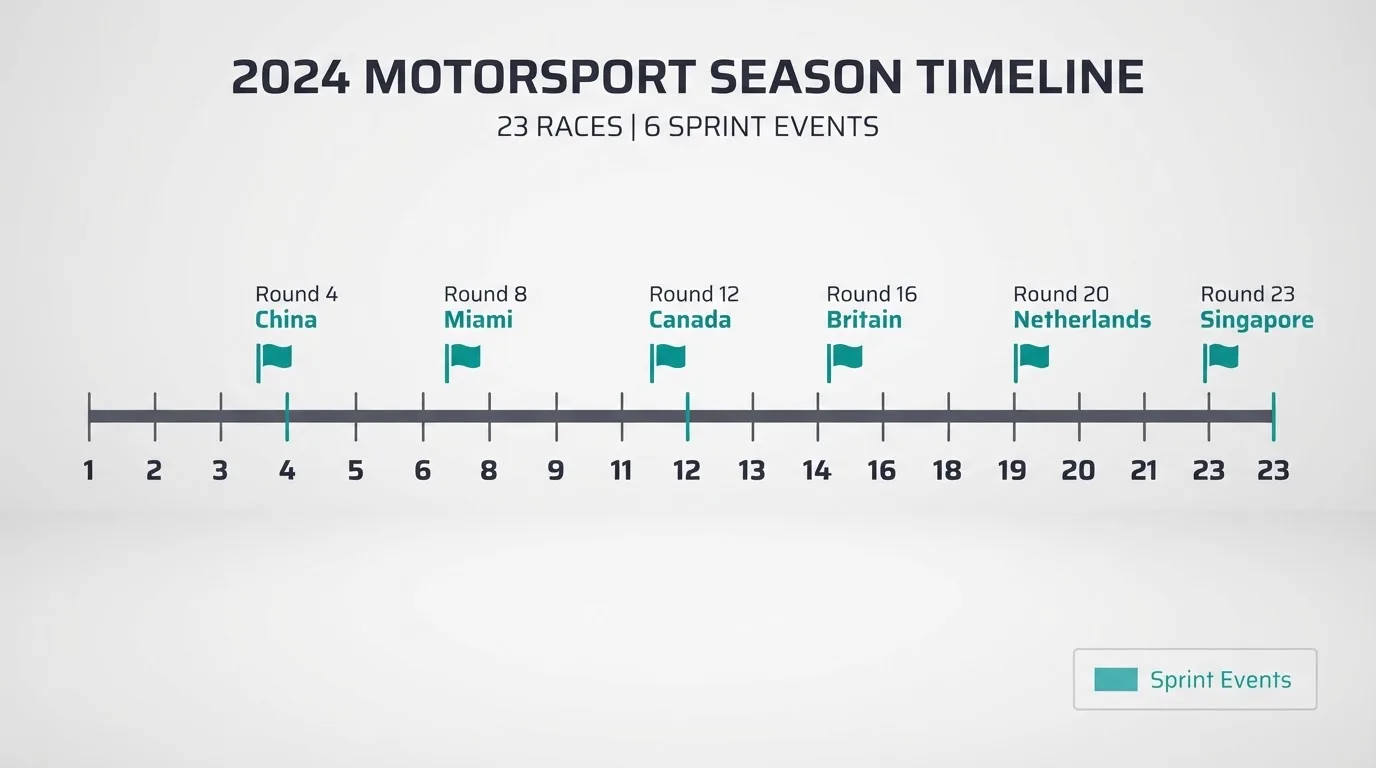
The 2026 FIA Formula One World Championship is the 77th running of the World Championship, with 23 Grands Prix and 11 teams. Originally 24 races were scheduled; the Saudi Arabian Grand Prix was cancelled, leaving 23 rounds from Australia in March to Abu Dhabi in December. Six of those rounds are sprint weekends: China, Miami, Canada, Britain, Netherlands and Singapore. The season opened with the Australian Grand Prix at Albert Park, Melbourne on 8 March 2026 and ends with the Abu Dhabi Grand Prix at Yas Marina Circuit on 6 December 2026.
That calendar sets the cost the punter pays for the season, beyond the per-bet margin. A 23-race championship is a long exposure. A multi that survives the Australian Grand Prix has to clear Bahrain, Jeddah (now off), Imola and Monaco before the European summer. A Drivers’ Championship outright that opens at 4.00 in March can be 1.20 by July if the favourite dominates, and the punter who locked the early price has the same contract at the same number regardless of where the line moves later. The punter who waited is buying a price that has been marked by every bet that came before it.
The technical regulation change for 2026 removed the MGU-H, raised MGU-K output from 160 bhp to 470 bhp, and replaced DRS with active aerodynamics. The team cost cap rose from $135 million to $215 million. Both changes affect how markets are priced. A reg-change year widens outright margins because every team is rebuilding, and the early-season form guide is more guesswork than data. Punters backing a pre-season outright are paying an early-season margin across an entire championship, and championship margins are higher than race margins. Lando Norris is the reigning Drivers’ Champion in the 2026 season.
For the New Zealand punter, the calendar is also a time-zone matter. European races run overnight; Australian and Asian races run in the evening; the Las Vegas and São Paulo rounds run in the morning. Live betting is offered in TAB NZ’s apps. The cost of placing a live bet after the formation lap is the price the in-play market shows at that moment, which is set against the state of the race and typically carries a higher margin than the pre-race line.
How a Formula 1 bet actually gets placed — the mechanic from selection to payout
A bet on a Formula 1 driver or race is a sequence of decisions, each of which costs the punter something. It is worth seeing the sequence once, end to end, because every step in it has a price.
The punter opens the TAB NZ app — the only lawful route for a New Zealand resident — and confirms the account is funded. The TAB – Racing & Sports Betting app is published by the New Zealand Racing Board on the New Zealand App Store and was first released on 8 September 2014. The app carries a 17+ App Store age rating while stating customers must be 18 or over to bet. The 17+ versus 18 gap is an app-store tier, not a licence rule, and the operative age for betting is 18 under section 89 of the Racing Industry Act 2020. Betting under 18 is an offence.
The punter selects the market. TAB NZ takes fixed-odds and tote bets; its published betting rules define Win, Place, Each Way, Quinella, Exacta, Trifecta, First Four, Double, Treble, Daily Double, Running Double, Quaddie and Big6, plus Multis and Same Game Multis. A same-game multi is a multi whose legs come from one event — pole sitter, race winner, fastest lap — combined into one slip. The punter picks a driver, a stake and a bet type, and confirms.
The price is locked at the moment of confirmation. Live bets, where offered, are priced at the moment the bet is placed and the slip is confirmed, not at the moment the bet was opened in the bet builder. That timing matters. A multi whose last leg changes between the time the slip was opened and the time it was confirmed is settled at the confirming price, not the building price. The punter who watches a price move while building a slip and confirms late has bought the new price.
Settlement follows the official result. The official result for a Formula 1 race is the FIA classification; the official result for a Drivers’ Championship is the FIA-published final standings after the Abu Dhabi Grand Prix. Bets on abandoned or curtailed races are governed by TAB NZ’s published rules, which detail what happens to single bets, multi bets and each-way bets in specific circumstances. The punter who places a race-winner bet on a race that is red-flagged and not restarted relies on TAB NZ’s rules, not on the punter’s own sense of what happens.
Payout is credited to the account wallet. Withdrawal is a separate decision, with its own time and minimum. TAB NZ lists Trackside live race streaming with in-app betting, racing form, Blackbook and Jockey Challenge tools, and a simplified wallet for deposits and withdrawals. The punter who wants to bank winnings from a Drivers’ Championship outright that pays out in December — after the Abu Dhabi Grand Prix on 6 December 2026 — waits until the official classification is published before the payout lands.
The whole sequence is not complicated. What it costs is not complicated either, and that is the point: the cost is the margin, the stake, and the time value of money the punter commits to an unsettled position.
The top 10 F1 bookmakers a New Zealand punter actually meets — and what each one costs
New Zealand punters who search for “best Formula 1 betting sites” find ten names that recur in the comparison tables, reviews and affiliate pages that rank sportsbooks. Only two of them are lawful in New Zealand. The other eight carry F1 markets and have a global footprint, and they are all, by virtue of section 74AAA, on the wrong side of the law for serving a punter sitting in Auckland or Wellington. They sit in this ranking because New Zealand searchers see them; they are not, on that basis, choices the punter can lawfully place.
The two lawful operators are one business. TAB and Betcha are the two online brands of TAB New Zealand, run by Entain under a 25-year agreement signed in 2023. Entain is paid under a 50/50 share of gross profits, with at least $150 million a year flowing to TAB NZ for the first five years and a one-off $100 million payment to the racing sector. The structure means the two brands are not rivals in any commercial sense. They share account infrastructure, the same betting rules, the same wallet mechanics, the same harm-minimisation tools and the same New Zealand consumer framework. The page presents both because the punter is likely to meet both, and treating them as competitors misreads the market.
The eight offshore brands are presented for the same reason: the punter meets them and needs to see, in one place, what each one offers and what each one does not have for a New Zealand resident. Each is marked not licensed in New Zealand.
What follows is the rank. The depth of each write-up varies with what is known about the brand on Formula 1 and with what distinguishes it from its neighbour.
| Brand | New Zealand status | Key terms |
|---|---|---|
| TAB | Lawful provider | Racing Industry Act 2020, section 74AAA |
| Betcha | Lawful provider | Racing Industry Act 2020, section 74AAA |
| Roobet | Not licensed in New Zealand | Curaçao licence (OGL/2024/687/0427) |
| Spinbara | Not licensed in New Zealand | No valid New Zealand licence |
| Sportaza | Not licensed in New Zealand | Anjouan licence (ALSI-202606064-FI2) |
| Thunderpick | Not licensed in New Zealand | Curaçao licence (OGL/2024/677/0722) |
| Rooster.bet | Not licensed in New Zealand | Tobique Gaming Commission licence (No. 0000002) |
| Glorion | Not licensed in New Zealand | No valid New Zealand licence |
| RoyalistPlay | Not licensed in New Zealand | Tobique Gaming Commission licence (No. 0000002) |
| BetAlright | Not licensed in New Zealand | No valid New Zealand licence |
TAB is one of two online brands of TAB New Zealand, the sole provider lawfully offering racing and sports betting to people in New Zealand under section 74AAA of the Racing Industry Act 2020, in force since 28 June 2025. There is no licensing route for another bookmaker and no licence register, because there is only this one lawful provider. The Department of Internal Affairs told unlicensed providers serving New Zealand to withdraw with immediate effect.
For F1 specifically, TAB carries race-winner markets, qualifying match bets, fastest-lap markets, podium finishes and the Drivers’ Championship outright. The F1 coverage is part of a wider racing and sports book that includes horse and harness racing, rugby union and rugby league, and other sports, pre-match and live. The TAB – Racing & Sports Betting app is published by the New Zealand Racing Board, first released on 8 September 2014, and carries a 17+ App Store age rating with a stated 18+ betting age.
The cost the punter pays for the lawful privilege is straightforward. The TAB NZ margin on F1 markets sits in the same 5% to 9% band that other major sportsbooks charge on motorsport; the law does not fix a margin and the bookmaker does not publish one. The punter also pays in product shape: TAB NZ is built around a tote heritage and a domestic racing calendar, and the F1 product, while complete, is not the centre of the offer. Punters looking for a deep F1 schedule of props, sub-markets or seasonal derivatives that offshore books publish will not find them at TAB. What they get in return is the only account on which New Zealand consumer law, problem-gambling tools and a domestic complaints route apply.
Betcha (betcha.co.nz) — the second TAB NZ brand, with the F1 product bundled in
Betcha is the second of the two TAB NZ online brands and the legal sibling of TAB, not a competitor. The app was published on the New Zealand App Store by Entain New Zealand Limited, first released on 6 August 2024. Betcha covers horse, greyhound and harness racing plus rugby, NRL, MMA/UFC, NBA, NFL, tennis, cricket, football, motorsports and esports.
For F1, the same race-winner, qualifying, fastest-lap and Drivers’ Championship markets that TAB carries are available, with the same settlement rules and the same New Zealand harm-minimisation framework. An exclusion applied through either brand applies across both. The punter who opens a Betcha account is opening a TAB NZ account and inherits the same wallet treatment and the same 18+ age rule.
The cost the punter pays by choosing Betcha over TAB is the cost of a slightly different app and a different promotional cadence. Both brands run bonus-bet promotions. The page describes what an offer costs in turnover and minimum price elsewhere; both brands set the same terms that any other New Zealand bookmaker sets, but no other New Zealand bookmaker exists.
The Betcha product carries a slightly broader sports list than TAB, including MMA and esports alongside motorsports. The punter who wants motorsport adjacent to UFC and Counter-Strike on one slip finds more variety at Betcha; the punter who wants the deepest racing form and tote history finds more at TAB. Underneath, both brands settle the same F1 race-winner market at the same price at any given moment.
Roobet — not licensed in New Zealand
Roobet is a Curaçao-licensed sportsbook and casino under holder Raw Entertainment B.V. The licence is OGL/2024/687/0427. The licence gives no right to take bets from people in New Zealand under section 74AAA of the Racing Industry Act 2020. The terms require players to be 18 or older; the platform covers soccer, basketball, tennis, Counter-Strike, FIFA, baseball, ice hockey, MMA and table tennis alongside a casino product.
For a New Zealand punter shopping for an F1 book, what Roobet offers that TAB and Betcha do not is a larger sportsbook list, a crypto wallet rail, and a casino product alongside the sportsbook. What it does not offer is a New Zealand consumer framework, a New Zealand harm-minimisation tool, or a domestic complaints route if a payout is disputed. The DIA warns that overseas operators may be in jurisdictions with minimal consumer safeguards, may not return unspent credits and may not pay out large wins.
The cost of using Roobet from New Zealand is not a margin the punter pays on the bet. It is the absence of recourse if the bet does not settle the way the punter expected, and the absence of a New Zealand address-verified account that ties back to a regulator the punter can write to.
Spinbara — not licensed in New Zealand
Spinbara is a Curaçao-or-equivalent offshore operator that advertises a first-deposit bonus of 100% up to EUR 100, a sport crypto welcome bonus of 100% up to 200 USDT on its English site, and a casino welcome bonus of 100% up to EUR 500 plus 200 free spins. The brand names no licence that applies in New Zealand under section 74AAA.
The F1 product at Spinbara carries the standard race-winner, podium and outright markets alongside a casino product. The punter who lands on Spinbara from a search-result page is paying for the welcome bonuses in the way every bookmaker welcome bonus is paid for: turnover requirements, minimum-price rules on qualifying bets, and deadlines attached to the offer. The publisher of the comparison page describes the offer in headline percentages; the punter who reads the small print finds the rule that turns the headline into a longer commitment.
The cost beyond the offer is the same offshore cost every offshore brand charges: no New Zealand complaints route, no regulator the punter can write to, and a settlement process run from outside the New Zealand jurisdiction. A punter who wins a Drivers’ Championship outright at Spinbara and lives in New Zealand is depending on the operator’s own terms and on whatever licence regime the operator is bound by. That regime is not New Zealand.
Sportaza — not licensed in New Zealand
Sportaza operates under an Anjouan licence, ALSI-202606064-FI2. This gives no right to take bets from people in New Zealand. Sportaza’s terms cover cash out before an event or market is finalised, Bet Builder, multiples, Asian lines and interval markets in 1, 5, 10 or 15 minute ranges. The 1/5/10/15-minute interval markets are the distinctive feature for racing punters who think in stint-by-stint terms.
For an F1 book, Sportaza brings a more granular in-play product than most operators, and the Bet Builder mechanic that lets a punter combine several F1 legs into one slip. The cost of that product is again the absence of a New Zealand licence and a New Zealand complaints route. A Bet Builder at Sportaza that contains a void leg is settled as a void slip; the punter who reads the rule sees the void, the punter who does not discovers it after a void leg has killed a four-leg multi.
The punter looking for an F1 in-play product with deep granularity finds more at Sportaza than at TAB NZ; the punter looking for an account that holds a New Zealand address, a domestic harm-minimisation tool and a local regulator finds none of those things at Sportaza.
Thunderpick — not licensed in New Zealand
Thunderpick is esports-first, covering Counter-Strike 2, League of Legends, Dota 2 and Valorant, with a sportsbook that includes a cash-out feature and markets from the Champions League to the NFL. The brand names a Curaçao licence, OGL/2024/677/0722, holder Paloma Media B.V. No right to take bets from people in New Zealand exists.
F1 sits in the broader sportsbook at Thunderpick; the esports product is the centre of the offer. The punter looking for an F1 outright beside an esports League of Legends market on one slip will find one. The punter looking for the deepest F1 outright price and the most refined qualifying match bet will not. Thunderpick is a useful sportsbook for a punter whose calendar is mostly esports and who wants F1 as a weekend add-on; it is not where a serious F1 punter anchors a season.
The cost is the offshore cost: no New Zealand complaints route, no local regulator, and a Curaçao framework the punter has to write to in the unlikely event of an unresolved dispute.
Rooster.bet — not licensed in New Zealand
Rooster.bet operates under a Tobique Gaming Commission e-gaming licence, number 0000002, holder Novatrix SRL. The sportsbook shows Live, Sports Promotions, Results, Schedule, E-sports and Predictions sections, and prices in six formats.
The Predictions section is the noteworthy product. The platform publishes picks and tips alongside the sportsbook; the punter who lands on Rooster.bet from a search for “F1 betting tips” finds picks labelled as tips and a sportsbook. The cost of taking a published pick and placing the bet is the same offshore cost as every other unlicensed brand: no New Zealand complaints route, no domestic harm-minimisation tool, and a settlement process run outside the New Zealand jurisdiction.
A published pick is also what it is: a prediction written by the platform, not a guarantee of outcome. The punter who follows the Predictions section bets at the published price and pays the published margin. No published pick changes the margin.
Glorion — not licensed in New Zealand
Glorion names no licence that applies in New Zealand. The sportsbook carries pre-match and live betting, virtual sports, horse racing and esports, with markets grouped into popular, niche, indoor and outdoor sports plus entertainment events such as award shows and elections. The market grouping is the product; punters can move from a Grand Prix outright into an election market on one slip.
For an F1 punter, that grouping is a curiosity. F1 sits in the outdoor-sports block. The punter looking for a multi that crosses motorsport and politics, on a platform that hosts both, finds more here than at a motorsport-specialist book. The punter looking for F1-specific product depth finds less.
The cost of the entertainment-events product is the framing. Esports and politics markets carry different risk profiles from motorsport, and the book that hosts them all is not necessarily the book that prices them all to the same standard. The punter who checks the F1 margin against the politics margin before placing will see where the operator’s pricing is sharpest.
RoyalistPlay — not licensed in New Zealand
RoyalistPlay operates under a Tobique Gaming Commission e-gaming licence, number 0000002, holder Novatrix SRL. The sportsbook carries live betting, sports promotions, results and a schedule, with football, basketball, tennis, handball, ice hockey, volleyball and table tennis among the top sports.
F1 is in the broader sportsbook, but F1 is not where RoyalistPlay’s product is built. A punter whose weekend is mostly football or table tennis will find the deep schedule here; a punter whose weekend is the Monaco Grand Prix will not. The competitive position on F1 is a sportsbook of convenience, not a specialist’s book.
The offshore cost applies: no New Zealand complaints route, no domestic regulator, a settlement process run from a Tobique framework the punter does not normally engage with.
BetAlright — not licensed in New Zealand
BetAlright names no licence that applies in New Zealand. The sportsbook covers football, tennis, table tennis, basketball, ice hockey, American football and baseball, with Live Betting and Virtual Sports sections. The product list is North American-skewed: American football, baseball and basketball carry weight, F1 sits in the broader sportsbook.
The punter looking for the strongest F1 line at BetAlright will find the same race-winner and outright markets other unlicensed books offer, priced to a margin comparable to the offshore median. The cost is the offshore cost, with no F1-specific specialisation and no New Zealand framework.
The punter looking for a fun bet in a Las Vegas Grand Prix weekend while the NFL season runs alongside finds a one-stop shop here; the punter looking for an F1-anchored season does not find BetAlright to be the place the season sits.
How the TAB NZ monopoly actually shapes the cost of an F1 bet
The New Zealand shape is unique in this pack: one bookmaker with the law on its side, several books the punter can see but cannot lawfully use, and a regulator that tells the punter what the offshore books cannot do for them. The cost of the monopoly is not a single number. It is several costs the punter pays in different forms.
The first cost is the margin TAB NZ charges on F1 markets. The law does not publish a margin figure and TAB NZ does not publish one either; the margin sits inside the odds the punter sees on the slip and runs in the same 5% to 9% band that the major global sportsbooks charge. The punter is not paying a monopoly premium on margin; the punter is paying whatever margin TAB NZ chooses to set.
The second cost is the product. TAB NZ is a racing-and-sports bookmaker whose centre is a tote heritage and a domestic code list; F1 is one sport on a list that runs from rugby to cricket. The offshore books listed above carry F1 alongside a deeper set of derivative markets — fastest-lap match bets at multiple price points, sub-market props on safety cars and pit-stop windows, season-long position markets by team. TAB NZ’s F1 product covers race-winner, qualifying, fastest-lap and outright championship markets; it does not carry the full depth of derivative markets some offshore books publish. The punter looking for that depth has to leave the legal market, and leaving the legal market is leaving the consumer framework.
The third cost is the offer. Only TAB NZ may run a New Zealand betting promotion; offshore bonus offers, “free bet” headlines, “boosted odds” tags and “risk-free” tokens that look attractive in comparison tables cannot be claimed by a New Zealand punter through a New Zealand-facing account without putting the punter on the wrong side of section 74AAA. The punter reading a comparison page that lists a 100% deposit bonus at one brand and a $200 free bet at another reads in dollars; the punter acting on the comparison reads in New Zealand law.
The fourth cost is time. A bet on the Drivers’ Championship that pays out only after the Abu Dhabi Grand Prix is a settled bet in December. The punter who waited for early-season value at 4.00 and held the bet through 22 races has had a $50 wager earning nothing for nine months. The opportunity cost is the punter’s own; the wager is locked either way.
The legal frame a New Zealand F1 punter actually sits inside
The law that governs an F1 bet placed in New Zealand runs through three statutes and one operator. The Racing Industry Act 2020 establishes TAB NZ as the sole betting provider for racing and sports in New Zealand; the Racing Industry Amendment Act 2025 inserted section 74AAA on 28 June 2025; the Gambling Act 2003 governs the wider gambling regime and creates the Department of Internal Affairs’ role as the regulator. The Online Casino Gambling Act 2026 licenses online casino gambling only and does not extend the betting monopoly.
The Department of Internal Affairs is the gambling regulator under the Gambling Act 2003 and monitors compliance with the betting prohibition. On 28 June 2025 the Department told unlicensed providers serving New Zealand residents to withdraw with immediate effect; it has not, since then, established a licensing route for another bookmaker. There is no licence register for betting because there is only one lawful provider.
The Online Casino Gambling Act 2026 is a separate matter. It licenses online casino gambling only. TAB NZ winning the right to apply for a casino licence does not extend its betting monopoly, and the casino law’s harm-minimisation tools — including the future online-casino exclusion register — apply to casino play, not to sports betting. The punter who confuses the two regimes finds tools that exist for casino and not for sports.
Greyhound racing is closing in stages from 1 August 2026. From that date offshore operators may not take bets on greyhound races under section 74AAA either. The greyhound ban matters for racing punters; for F1 punters the calendar runs on thoroughbred and harness codes alongside the motor calendar, and the greyhound calendar change does not affect F1 directly.
Betting on politics and novelty markets is not established in the New Zealand market. The punter looking for an F1 Drivers’ Championship crossed with a market on the Constructors’ or on a mid-season driver market does so on the offshore books that publish those combinations; none of them is lawful in New Zealand.
What the punter pays the regulator and the operator in tax
For the punter, recreational gambling winnings are generally not taxable under Inland Revenue guidance. Prize money from TAB horse, dog and trotting races is not taxable. A person who bets as a business is a different case — the operator of a betting business pays the Problem Gambling Levy of 0.74% from 1 July 2025 to 30 June 2028, and overseas operators supplying New Zealand residents pay online gambling duty of 12% of profits since 1 July 2024, rising to 16% from 1 January 2027.
That duty payment does not make an offer lawful. The punter who reads offshore marketing that points to online gambling duty as evidence of regulatory legitimacy reads a tax payment, not a New Zealand licence. The point-of-consumption charge on offshore racing and sports bets ceased on 30 June 2026. None of these levies changes the position that only TAB NZ is lawful for a New Zealand-resident punter on an F1 race.
The punter who wins $5,000 on a Drivers’ Championship outright at TAB NZ collects the $5,000 into the account and is not taxed on it as income; the punter who wins the same amount on a same-race multi at an offshore book has the same tax outcome, but the offshore book has been unlawful in serving the bet.
Safer gambling tools a New Zealand punter can actually use
The harm-minimisation framework is built around the TAB NZ account. TAB NZ lists deposit limits, time-outs and self-exclusion in its apps, and an exclusion applied at one brand applies across both TAB and Betcha. The age for TAB NZ betting is 18; land-based casinos are 20 — the two ages are not the same and a punter aged 18 to 19 can lawfully bet on TAB NZ but cannot enter a land-based casino.
The free Gambling Helpline at 0800 654 655 and the text line at 8006 are listed in the TAB NZ app and run independently of the bookmaker. Safer Gambling Aotearoa is the government-facing organisation. There is no single national online-betting exclusion register; the register the casino law will require is for online casinos only, and applies to casino play, not to F1 betting.
TAB NZ accounts need a verified New Zealand address and ID. The verification is the entry cost the offshore books do not require; it is also the cost that ties the punter to a domestic account and the protections that come with one. The offshore books named above accept accounts from anywhere their licence covers, and offer no New Zealand-specific harm-minimisation tools.
For a punter who wants to self-exclude from F1 betting entirely, the TAB NZ exclusion is the route. There is no registry that aggregates exclusions across offshore books, and there is no regulator a New Zealand resident can write to asking for an offshore book to be added to a New Zealand exclusion. The exclusion is local, and so is the effect.
What an F1 betting strategy actually costs the punter who runs it
A punter running a serious F1 season strategy is paying for it in three places that do not look like payments.
The first is the per-bet margin. Every wager — race-winner, qualifying match bet, fastest-lap multi, Drivers’ Championship outright — carries a margin of 5% to 9% on the two-way price, more on a three-way and more on a long-shot outright. A punter placing $50 per race across a 23-race season wagers $1,150 in stakes and pays the margin on every leg. The total margin paid is the volume times the market margin; at $1,150 in volume and a midpoint margin of 7%, the season-long margin is around $80. That is the cost the punter must beat to be ahead for the season.
The second is the offer cost. TAB NZ runs bonus-bet promotions. A “bonus bet” has a turnover requirement, a minimum price on the qualifying bet and a deadline. The punter who claims a $50 bonus bet and clears it pays the wagering turnover the bonus carries; the punter who claims a $200 bonus bet pays four times that turnover. The arithmetic is offered in the offer’s own terms, and the offer’s headline figure is the amount the punter can win, not the amount the punter will keep.
The third is the opportunity cost of an unsettled bet. A Drivers’ Championship outright is a nine-month commitment. A multi that runs across three races ties the stake to three outcomes. The punter whose strategy leaves $200 of stake tied up across March-to-November markets is paying the cost of money the punter cannot deploy elsewhere.
Promotions, bonuses and “free bets” — the cost behind the headline
Bonus bets are a TAB NZ offer; no other New Zealand bookmaker may lawfully offer them to a New Zealand resident. A bonus bet usually pays back the winnings, not the stake, and the headline amount is the bonus the bookmaker credits, not the profit the punter can keep. A $50 bonus bet at odds of 4.00 wins $150 of profit if it lands; the punter does not receive the $50 stake back. A $200 bonus bet at odds of 3.00 wins $400 of profit if it lands; the punter does not receive the $200 stake back. The headline number is the offer’s size; the retained number is the punter’s profit.
The offer usually carries turnover. A bonus bet whose headline says $50 may require the punter to wager the bonus amount once, twice or more before the winnings can be withdrawn. The qualifying bet for the offer is usually subject to a minimum price — bets at odds shorter than the minimum do not qualify. The bonus offer usually carries a deadline — a window the punter must clear the bonus in or it expires.
A “boosted odds” headline is the bookmaker marking a price higher than the regular market. The boosted price carries the bookmaker’s margin just as the regular price does; the boost is a marketing number, not a margin-free offer. The punter taking the boosted odds gets the headline price; the bookmaker still keeps the margin on the volume.
A “risk-free” bet is a refunded stake if the bet loses. The refund is usually a bonus bet, not cash, and the bonus bet carries the same turnover and minimum-price rules any bonus bet carries. The punter reading “risk-free” reads zero risk; the punter clearing the bonus reads the actual cost.
How a New Zealand punter weighs the comparison tables online
Comparison tables rank sportsbooks by headline offer, by sport coverage, by payment method. The New Zealand punter reading those tables needs to weigh three columns the tables do not always carry.
The first is licence status in New Zealand. A 5.0-rated offshore book and a 4.0-rated TAB NZ share the same F1 race-winner market on race day, and the offshore book cannot lawfully take the New Zealand-resident’s bet on it. The rating score is a global score; the licence is the New Zealand score. The two must agree on a comparison table, and they usually do not.
The second is New Zealand harm-minimisation tools. TAB NZ carries deposit limits, time-outs and self-exclusion in its app. The offshore books carry their own self-exclusion at the account level, often through the same Curaçao framework. The punter who wants a self-exclusion tool that follows them across brands cannot have one at an offshore book; the punter who wants a self-exclusion at TAB NZ has it across both TAB and Betcha immediately.
The third is the New Zealand complaints route. A punter who has a settlement dispute with TAB NZ has the Department of Internal Affairs as a regulator, and the DIA for complaints. A punter with a settlement dispute at an offshore book has the licensing regime the book sits in, which is not New Zealand. The law does not give the New Zealand resident a domestic court for an offshore dispute.
The calculation that belongs on this page — the margin on a notional two-way F1 price
The margin on a notional two-way Formula 1 market at decimal odds of 1.90 against 1.90 — an illustrative example, not a quoted price — works through the payout-share formula. With both sides priced at 1.90, the share of total staked that comes back to winning punters is , which is , or . That gives a payout share of about 0.9499, or about 95%. The margin — the bookmaker’s cut on every dollar the market takes — is one minus 0.95, or 5%. The 5% band, with conditions on how the line is built, is the cost every dollar wagered on a 1.90/1.90 market pays the bookmaker.
That figure is illustrative, not a market quote. Real-world F1 two-way lines sit close to even money on qualifying match bets and fastest-lap match bets between cars of similar pace, and the margin on those lines sits in the same band. Heavier-favourite lines — a championship leader at 1.40 against a backmarker at 3.50 — carry a higher margin, often 7% to 9%, because the bookmaker builds more overround into lopsided prices. Outright markets, where the field is wider and the prices range from 1.50 for a season favourite to 1,001 for a backmarker, carry margins that expand further as the field lengthens.
The punter who treats the 5% margin as the cost of a 1.90/1.90 line is paying 5% of stake in lost volume, on average, every race. The punter who treats the 7% to 9% margin as the cost of a heavy-favourite line is paying more. The punter who treats the outright margin as the cost of a championship bet is paying most. The band is the calculation’s point: a single figure misreads the market.
Choosing between TAB NZ and the offshore alternatives a New Zealand punter sees
The choice looks like a comparison; it is a rule. TAB NZ and Betcha are the only lawful options. The offshore books named above are lawful in the jurisdictions where they hold licences, and unlawful for serving a person in New Zealand. The punter who opens an account at Spinbara from a Christchurch address is opening it from a country where the operator is on notice from the regulator not to take the bet.
The honest framing for the punter is the framing the regulator uses. TAB NZ and Betcha are the only lawful route, with New Zealand harm-minimisation tools, regulator oversight and a domestic complaints framework. The offshore books are unlawful for the operator to serve New Zealand, have no New Zealand complaints route, carry the regulator’s stated risks and may apply limits or refuse withdrawals in ways a domestic account does not. Neither is “the safe choice” by default. One is the lawful choice; the other carries risks the regulator has named and a recourse the punter does not have.
For a punter who has decided to bet on the Australian Grand Prix, the Drivers’ Championship or any F1 market, TAB NZ and Betcha are the only two lawful platforms on which to place the bet. The product is complete for race-winner, qualifying, fastest-lap, podium and outright markets. The price carries a margin in the 5% to 9% band on most two-way prices. The offer terms are the bookmaker’s own. The harm-minimisation framework is local. That is the package, and it is the only package a New Zealand-resident punter can lawfully buy.
Where the F1 punter goes for help before the betting starts
The Gambling Helpline at 0800 654 655 is free and runs nationally; the text line at 8006 is free and runs nationally. Safer Gambling Aotearoa is the government-facing organisation for problem gambling advice. TAB NZ’s safer gambling tools sit inside the account: deposit limits cap how much the punter can fund; time-outs pause the account for a chosen period; self-exclusion closes the account for a chosen period and applies across both TAB and Betcha.
For a punter who needs help setting a limit before the Australian Grand Prix weekend opens, the deposit-limit tool is in the TAB NZ app under safer gambling. For a punter who needs time away from a sport where the season runs nine months, the time-out covers exactly that. For a punter who needs to close the account, self-exclusion closes it across both brands and the punter cannot re-open it in the exclusion period.
The cost of not using these tools is the cost that builds over a season of small bets that feel like entertainment and stop feeling like entertainment somewhere in mid-summer. The punter who uses them pays nothing; the punter who does not use them pays the season-long margin on every bet, plus whatever the season did to the punter’s bankroll beyond the margin.
Pricing for F1 in the New Zealand market — what changes race to race
The price of a race-winner market moves through the week before a Grand Prix. Friday practice prices are set against the championship standings, last race’s form and the upgrades visible on the car. Saturday qualifying prices shift with the times set in qualifying. Sunday pre-race prices reflect the grid and the strategy call. In-race prices reflect gaps and gaps-to-lead, tyre ages and pit windows. Each shift carries the bookmaker’s margin; the band stays the same as the price moves.
A punter who took the early-week price on Friday and held the bet through Sunday has the Friday price. A punter who placed the bet in-race has the in-race price. The cost difference between Friday and Sunday is the cost of waiting, and the wait is the punter’s own bet against the closing line.
For outright markets, the price moves over weeks. The Drivers’ Championship outright that opens at 4.00 in early March can be 2.50 by mid-season if the favourite dominates, or 6.00 if the favourite retires from two races. The punter who locked 4.00 in March has a 4.00 contract in June regardless of where the public market is trading. The cost of locking early is the cost of capital the punter cannot reassign.
The punter with a season strategy who places 10 outright bets at $20 each pays $200 in stakes. With a margin of 7% to 9% on outrights, the season-long margin on $200 of outright stakes is roughly $14 to $18. That is the cost of the strategy, before the punter’s picks are judged.
Frequently asked questions
Can you bet on F1 in New Zealand?
Yes. New Zealand residents can lawfully bet on Formula 1 through TAB NZ and Betcha, the two online brands of TAB New Zealand, the sole provider lawfully offering racing and sports betting to people in New Zealand. The age for betting is 18. No other bookmaker may lawfully take such a bet from a person in New Zealand; the Department of Internal Affairs has told unlicensed providers to withdraw from the New Zealand market.
Which bookmaker may lawfully take sports and racing bets in New Zealand?
TAB NZ is the only bookmaker lawfully offering online sports and racing bets to people in New Zealand, trading as TAB and as Betcha. The legal basis is section 74AAA of the Racing Industry Act 2020. There is no licensing route for another bookmaker. Both brands carry F1 markets, run by Entain under a 25-year partnership, and an exclusion applied at one applies across both.
How is the return on a bet worked out from the stake and the odds?
The return is the stake multiplied by the decimal odds. On a $20 wager at odds of 3.50, the return is $70, made up of the $20 stake and $50 of profit. On a $10 wager at odds of 1.85, the return is $18.50, made up of the $10 stake and $8.50 of profit. The stake is the punter’s cost; the rest is the bookmaker’s promise to pay. For a multi, the legs multiply into one combined price.
What is the bookmaker’s margin and how can it be seen in the odds?
The margin is the bookmaker’s cut on a market, built into every price so that total stakes on all outcomes pay back less than they took in. For a two-way market at 1.90 against 1.90, the payout share across both outcomes is , which is about 95%, and the margin is the other 5%. Heavier-favourite lines carry margins of 7% to 9%; outright championship markets carry wider margins still. The margin is the cost every punter pays on every dollar wagered, expressed in the odds rather than as a line item.
What F1 markets does TAB NZ carry for a New Zealand punter?
TAB NZ carries race-winner markets, qualifying match bets, fastest-lap markets, podium-finish markets, and Drivers’ and Constructors’ Championship outrights. Live betting is listed in the TAB NZ apps and is priced at the moment the bet is confirmed, not at the moment the slip is opened. Settlement follows the FIA classification for the race and the FIA-published final standings for the championship. Same-game multis let the punter combine several legs from one race on a single slip, and a void leg voids the whole slip.
Published by the Nzbettingtips team.